|
 |
Undergraduate category awardees: Chase Latyak (right) and Duncan Kuchar (left); not pictured, grduate category awardees: Romeo Perlstein and co-author Sai Srujana Theerthala |
|
Four students from the University of Maryland’s (UMD) A. James Clark School of Engineering earned top honors for research at the 2026 American Institute of Aeronautics and Astronautics (AIAA) Region 1 Student Conference.
Competing against peers from across the Northeast, UMD students placed in both undergraduate and graduate categories, with projects spanning hypersonics, autonomous systems, and human spaceflight technologies.
First place: Improved modeling for meteoroid fragmentation
Additional Honors
Latyak’s research also garnered him UMD’s 2026 Winston Family Papers Award for Outstanding Thesis. The Winston Family Honors Writing Awards, established by UMD alumni Roger and Karen Winston, recognize the best short essays, research papers, and departmental theses produced by honors students across the university.
Senior aerospace engineering student Chase Latyak earned first place in the undergraduate category for his paper, “Free-Flight Aerodynamics of Ellipsoidal Clusters in Hypersonic Flow,” conducted under the mentorship of Professor Stuart Laurence.
Working in the High-Speed Aerodynamics and Propulsion Laboratory, Latyak’s research explores how meteoroids break apart in Earth’s atmosphere. Using hypersonic wind tunnel testing and machine learning techniques to track fragment behavior, he identified a clear trend between the length of a cluster and how much t expected to separate laterally.
“It is truly an honor to win best paper at the AIAA Region I Student Conference, especially because there were so many amazing presentations and papers shared from students across the Northeast,” said Latyak. “I would like to thank my faculty mentor Dr. Stuart Laurence, Ryan de Silva, and the rest of the High-Speed Aerodynamics and Propulsion Lab for the help and support that made this project possible. Having the opportunity to investigate a real-world problem through hands-on research and share that with others means so much, and I look forward to seeing where this research will go in the future!”
Latyak is an active member of Engineers Without Borders, the University Honors program, and Aerospace Engineering’s Honors Program. After graduation, he aims to begin his career in the aerospace industry at ATA Engineering, with future plans to pursue a master’s degree.
Undergraduate research drives racecar performance
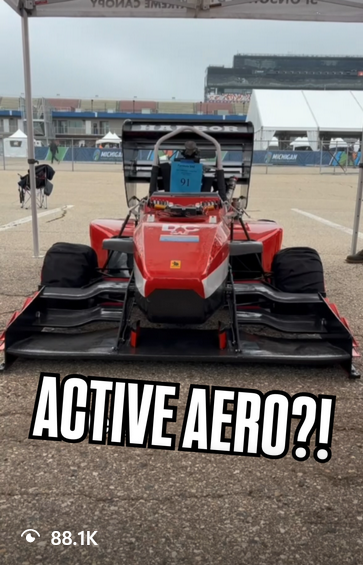
Duncan Kuchar, an aerospace engineering student in the B.S./M.S. program, took third in the undergraduate research category for his paper “Design and Implementation of a Six-Element Autonomous Active Aerodynamics System for Formula SAE.” Working with faculty mentors Adjunct Associate Professor Leonard J. Hamilton and Associate Professor Huan Xu, his project focused on improving racecar performance through autonomous systems.
The system dynamically adjusts a racecar’s aerodynamic surfaces in real time—balancing downforce for cornering with reduced drag on straightaways. Using onboard sensors and computing, the system operates autonomously, requiring no driver input.
“It is a massive honor to be recognized by the AIAA with this award. Bridging the gap between advanced aerodynamic theory and real-world mechanical reliability was a tremendous challenge, but seeing the Terps Racing active aero system perform flawlessly on the track, and now be recognized by industry professionals, makes every late night in the shop worth it,” said Kuchar. “I couldn't have done it without the guidance of my advisors and the Terps Racing team.”
On UMD’s Terps Racing team, Kuchar served as the Aerodynamics Lead and Driver for the team’s Formula SAE Internal Combustion team for three years. He has completed an internship with SpaceX and currently conducts acoustic research in Assistant Professor Chloe Johnson’s Aeroacoustics Laboratory. He plans to continue his studies at Maryland, focusing on machine learning applications in uncrewed aerial systems.
Improving astronaut mobility during EVAs
In the graduate category, a Maryland team earned third place for research supporting astronaut mobility and human-robot collaboration in space environments.
Master’s student Romeo Perlstein co-authored the paper “Inverse Kinematic Solutions for the BioBot Concept’s Umbilical Tending Manipulator,” with Srujana Theerthala under the mentorship of Professor David Akin at the Space Systems Laboratory.
The research is part of the BioBot concept, which aims to improve astronaut mobility during extravehicular activities (EVAs) by transferring life support systems from the astronaut to an autonomous lunar rover. A robotic manipulator maintains a continuous connection between the astronaut and the rover, requiring precise and reliable control.
The team evaluated three approaches to controlling the manipulator’s movement, comparing numerical methods with a newly developed closed-form solution to improve stability, smoothness, and efficiency.
“To me, research isn't about the recognition, but more about contributing to the advancement of space exploration,” said Perlstein. “That being said, I certainly won't turn down the cash prize!”
Perlstein is a graduate research assistant and certified diver in UMD’s Space Systems Laboratory. He performs research related to BioBot, as well as the Maryland Immersive Telepresence System (MITS), a robot control station incorporating an exoskeleton and extended reality to enable more intuitive robot teleoperation. He plans to pursue a Ph.D. focused on human spaceflight and human-robot collaboration.
His co-author, Theerthala, is an undergraduate researcher pursuing dual degrees in aerospace engineering and computer science. She contributes to the BioBot concept as part of her work at the Space Systems Laboratory and is also involved in organizing Bitcamp, a major student hackathon.
Preparing the next generation of aerospace innovators
The AIAA Regional Student Conferences provide students with the opportunity to present their original research, engage with industry professionals, and gain early experience in technical communication—skills essential to advancing in their respective technical fields.
“We’re excited to see our university student members gaining real-life experiences,” said AIAA CEO Clay Mowry in a press release. “For many students, these conferences are their first opportunity to formally present their research and receive valuable feedback from industry professionals. Their creativity and passion for aerospace was on full display and the future of aerospace is bright indeed.”
Related Articles:
Two Students Take Top Awards at AIAA YPSE Conference
Aircraft May Refuel Themselves - With Help From AI
Student Success at SAMPE 2026
Congratulations to our 2026 Department and College Honors and Award Recipients
Four Aerospace Engineering Faculty Named AIAA Associate Fellows
Three UMD Students Named Among Aviation Week Network’s Class of 2024 20 Twenties
Six Clark School Faculty Receive 2024 DURIP Awards
UMD Takes Second at VFS Design-Build-Vertical-Flight Competition
Seven UMD Students Receive Vertical Flight Foundation Scholarships
UMD Transplant Organ Flight Named Invention of the Year
May 5, 2026
|